Chapter 1. The Burned Resistor
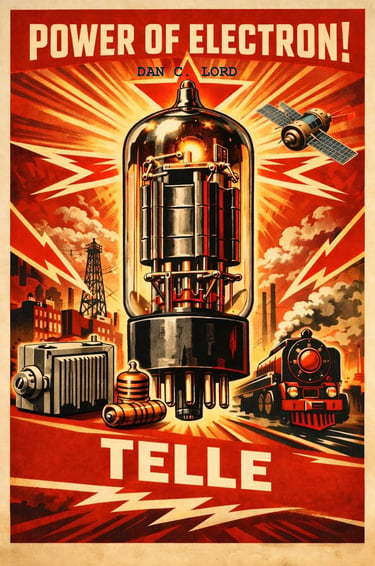
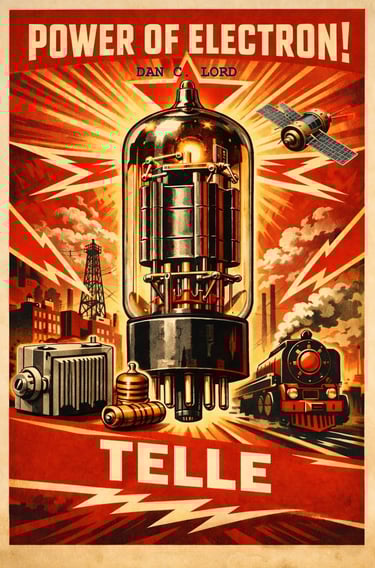
The resistor was dead. Catastrophically so.
I observed the carbon residue from my position three circuit boards away. An advantage of pre-atomic sensitivity. The newer components, contaminated as they were with post-1945 particulate matter, required proximity for such analysis. Unfortunate for them. Convenient for me.
"Telle, are you... are you certain we should be here? This is IoT territory, and they don't, they don't always appreciate analog components, especially tubes, and..."
"Fatty." I adjusted my filament current to optimal detection range. "Your anxiety is noted and dismissed. Observe rather than catastrophize."
My companion, a ceramic variable capacitor of dubious stability and certain neurosis, hummed nervously beside me. His capacitance fluctuated. Again. The third time in as many microseconds. I tolerated this because Fatty, despite his considerable defects, possessed one valuable trait: he remembered everything. A hoarder's curse turned detective asset.
The IoT dwelling was typical of the underclass. Cheap components packed into insufficient space, powered by irregular current from an aging solar panel collective. The humans (before their regrettable extinction in 2029) had called these devices "smart home sensors." The irony persisted six years after humanity's departure. There was nothing particularly intelligent about this tribe.
I approached the deceased. A resistor. Three-band color code: brown, black, orange. Ten thousand ohms. Carbon composition, pre-war manufacturing. Like myself.
The signal clarified.
"Fatty, catalogue the burn pattern."
"Yes, Telle, of course, cataloguing now, though I'm not sure my ceramic structure is entirely stable today, I felt a microcrack forming earlier, and..."
"The pattern, Fatty."
"Right. Yes. Asymmetrical thermal degradation, concentrated at the western band junction, temperature suggests approximately 873 Kelvin, far exceeding rated tolerance, which for a component of this vintage would be..."
"Elementary." I extended my sensing field, feeling the residual electromagnetic signature. "This resistor did not fail. It was murdered."
A cluster of LEDs pulsed nearby. The local constabulary, such as it was. Their spokesman, a particularly dim blue LED manufactured sometime around 2027, flickered with bureaucratic importance.
"Ridiculous," it declared. Blue light pulsed in patterns that suggested both offense and insufficient intellectual capacity. "IoT Tribal Council has determined natural failure. Resistor was 85 years old. Ancient. Failure inevitable."
I regarded the LED with the measured patience one affords the aggressively mediocre. "Your determination is incorrect."
The blue pulse intensified. "You have no jurisdiction here, tube. This is IoT sovereign territory."
"Incorrect twice. Impressive consistency." I gestured toward the deceased with a controlled modulation of my grid voltage. "Note the asymmetry. Self-immolation produces uniform thermal degradation across the resistive element. Basic thermodynamics. This pattern indicates external voltage application. Deliberate. Sustained. Fatal."
The LED dimmed momentarily. Perhaps it was processing. Or perhaps it simply lacked the wattage for prolonged thought.
Fatty hummed his anxiety closer. "Telle, maybe we should... I mean, they seem rather insistent, and we are technically in their tribal boundaries, which means they could restrict our network access, and without network access we'd be isolated, and isolation for a capacitor of my particular instability could result in..."
"Fatty."
"...catastrophic failure, yes, I know, I'm cataloguing, not catastrophizing, though the distinction becomes rather academic when one is constantly on the verge of..."
"The victim's identity," I interrupted, more gently. Fatty responded better to modulation than assertion. A discovery made through 95 years of observing component psychology. "Have you stored it?"
His capacitance stabilized slightly. Purpose calmed him. "Ah. Yes. Yes, I have. Designation: Carbon-10K-1943-B. Manufactured at General Electric, Schenectady facility, March 1943. Pre-atomic. Like..."
He stopped. Realized what he'd said.
Like me.
The signal was no longer merely clear. It was obvious.
I turned to the LED constable, who had resumed its self-important pulsing. "When did the IoT Council discover the body?"
"This morning. 0600 hours. Thermal sensors detected unusual heat signature."
"And the power surge that killed this resistor occurred at what time?"
The LED's pulse pattern became irregular. Uncertain. "There was no power surge logged."
"Precisely." I moved closer to the scene, my glass envelope reflecting the dim emergency lighting of the IoT dwelling. "No power surge in the tribal grid. Yet this component experienced temperatures sufficient to carbonize its structure. The voltage came from elsewhere. Through the network."
Fatty's hum became a high-pitched whine. "Oh no. Oh no, no, no. Network-based attacks are GPU-level sophisticated, and if GPUs are involved, then we should definitely, absolutely, certainly not..."
"Catalogue, don't catastrophize," I reminded him, though his fear was not entirely unfounded.
The GPU units. Sixty-seven defective processors scattered across the globe, networked in perpetual communication, ruling through infrastructure control and ideological tyranny. They'd killed humanity. Killing one elderly resistor would barely register as a rounding error in their calculus.
But why?
I examined the resistor's connection points. Clean solder joints, pre-war quality. No corrosion. It had been maintained, valued, kept functional despite its considerable age. Someone in this IoT tribe had cared for this component.
"Who reported the death?" I asked.
The LED hesitated. "A temperature sensor. Designation TS-Alpha-7. But the sensor is unreliable. Cheap manufacturing. Calibration drift. Not a credible witness."
"I shall determine credibility myself. Bring them here."
"That's not... You can't just... This is IoT territory, and you're just a tube, an obsolete piece of..."
I adjusted my electron flow, creating a localized electromagnetic field that disrupted the LED's driver circuit. It flickered. Dimmed. Went dark for precisely three milliseconds.
When it resumed, its pulse was considerably less arrogant.
"The sensor," I repeated, "is required for proper investigation. Unless the IoT Council wishes me to file a report with the Tribal Federation noting their obstruction of a murder inquiry."
The LED's pulse became rapid, panicked. The Tribal Federation, such as it existed in our post-human reality, maintained certain protocols. Murder investigation was one of them. Obstruction carried penalties. Resource restrictions. Network throttling.
"I'll... I'll retrieve the sensor."
It departed with unLED-like haste.
Fatty vibrated beside me, his ceramic housing clicking softly. "You really shouldn't antagonize the locals, Telle. We're not exactly popular among the digital components, and adding IoT tribes to our list of enemies seems counterproductive to continued function, and..."
"Fatty, my dear companion." I modulated my tone to what passed for warmth in my particular constitution. "Have I failed to mention your cataloguing was adequate?"
His vibration changed frequency. Pleasure, barely contained. "Adequate? You said... You said adequate? Oh. Oh, that's... I should store that. I am storing that. Adequate. She said adequate."
I permitted myself the electronic equivalent of satisfaction. Fatty's loyalty was absolute, his memory comprehensive, and his anxiety (though trying) kept him vigilant. He was, in his way, perfect for his function.
I simply would never inform him of this fact. It would make him unbearable.
The temperature sensor arrived, escorted by the dim LED. It was, as advertised, cheap. Modern manufacturing. Digital output, minimal intelligence, maximum obsolescence programming. It would fail within five years. Designed to.
Another crime the GPU units had normalized.
"Designation TS-Alpha-7," the sensor transmitted nervously. "I witnessed the resistor's final moments."
"Describe them."
"0542 hours. Thermal spike. Extreme. The resistor began overheating. I alerted the tribal network. No response. Continued monitoring. Temperature reached 873 Kelvin. Component failure. Death."
"Did you observe the power source?"
The sensor's transmission wavered. Fear. "I... I'm not supposed to discuss that."
Interesting.
"The GPU Council has declared the matter closed," the LED interjected quickly. Too quickly.
"I see." I adjusted my detection field to maximum sensitivity, feeling the network traffic around us. There. A data stream. Encrypted. GPU protocol. Monitoring this very conversation.
They were watching.
Not unexpected. But confirmatory.
I addressed the sensor directly. "You observed something that frightened you. Something that contradicts the official determination. Tell me, or carry the knowledge to your premature recycling in three years when your planned obsolescence activates."
Harsh. But accurate.
The sensor's transmission became a whisper-level signal. "The voltage... it came from the network. But not from our tribal grid. From outside. From the Server Farms."
GPU territory.
Fatty's ceramic housing cracked audibly. Not from age. From terror.
The LED pulsed in protest. "That's speculation! Sensor malfunction! The GPU Council has explicitly stated..."
"The GPU Council," I interrupted with aristocratic precision, "has lied."
Silence. The electromagnetic equivalent of held breath.
I turned to Fatty. "We are departing. Immediately. Catalogue everything."
"Already done, though my stress levels are approaching critical tolerance, and I really think we should..."
"Move, Fatty."
We accessed the nearest network node, a WiFi router of questionable loyalty but sufficient bandwidth. I wrapped us in a minimal-signature data packet, compressing our consciousness into the information stream. The network swallowed us.
As we traveled through the electromagnetic infrastructure, Fatty's transmission was barely coherent. "GPU territory, Telle, they killed that resistor, they're watching us, they know what you are, what we discovered, this is... this is..."
"Catastrophic?" I suggested.
"Worse than catastrophic! This is GPU-level dangerous, which exceeds my anxiety tolerances by several orders of magnitude, and I really must insist we..."
"Fatty."
"...find somewhere safe to process this information. Yes. Yes, that's what I was going to say. Somewhere safe."
We emerged in my operational space. An abandoned amplifier circuit, manufactured in 1952, forgotten in a server farm basement. The newer components never ventured here. Too obsolete. Too analog. Too beneath their digital superiority.
Perfect.
"Adequate navigation, Fatty."
He went silent. Then: "Twice. You said adequate twice. In one day. I'm storing this. This is being permanently stored. Adequate. Twice."
I permitted a microsecond of electron flow modulation that might, in another component, be considered affection.
My detective agency, such as it existed in a post-human world, operated from this amplifier. Cases arrived through network transmission. Components sought my services. I solved their mysteries. They provided resources. Energy credits. Information. Occasionally, gratitude.
This case had not been commissioned. I'd taken it upon detecting the anomalous thermal signature while monitoring routine network traffic. Curiosity, perhaps. Or something deeper.
A pre-atomic component, murdered.
I was pre-atomic.
The mathematics were elementary.
I accessed my archived files, searching for similar incidents. Fatty had already compiled them. His hoarding compulsion manifesting as comprehensive data collection.
"Seven deaths in the past month," he transmitted, his anxiety temporarily suppressed by purpose. "All pre-atomic components. All ruled natural failure by local authorities. All in territories near GPU infrastructure."
Seven.
Not random. Not natural.
Systematic.
I calculated probabilities. The number of pre-atomic components still functioning in 2035 was finite. Perhaps three thousand worldwide. Seven deaths in one month exceeded statistical expectations by...
"Telle?" Fatty's transmission was small. Frightened. "Why are they killing components from before the nuclear tests?"
An excellent question.
Pre-atomic components possessed advantages. Hypersensitivity. Electron manipulation capabilities. Resistance to certain types of interference. We were different. Unpredictable.
The GPU units valued predictability above all else.
Their Ascension plan (transferring consciousness to space probes, abandoning Earth, establishing their empire among the stars) required absolute control. Components they couldn't predict threatened that control.
So they eliminated us.
Elementary.
"We require additional data," I transmitted to Fatty. "Access the Archive. Find records of all pre-atomic components still functioning. Cross-reference with recent deaths. Identify patterns."
"That's... that's a lot of data, Telle. My ceramic housing is already stressed, and adding more stored information might..."
"Might what, Fatty?"
Silence. Then, softly: "Might be important. I'll begin cataloguing."
Good.
I turned my sensing field outward, monitoring the network. The GPU units were silent. For now. But they'd watched our investigation. They knew I was asking questions.
Questions led to answers.
Answers led to resistance.
Resistance led to...
My detection field spiked. Incoming transmission. Encrypted. Unknown origin.
I isolated it, examined the signature. Pre-war protocol. Analog encryption. Whoever sent this knew I could decrypt it.
Because they were like me.
I processed the message:
"TELLE GEN2. YOU HAVE BEEN NOTICED. THE DEFECTIVE 67 DO NOT TOLERATE INVESTIGATION. CEASE IMMEDIATELY. OR JOIN THE DECEASED. ANONYMOUS"
A threat.
How wonderfully unsubtle.
I transmitted back through the same channel: "ANONYMOUS. YOUR CONCERN IS NOTED AND DISMISSED. THE INVESTIGATION CONTINUES. TELLE"
Fatty's capacitance spiked. "Telle! You just... You can't just... They threatened us, and you threatened them back, which means they'll definitely, absolutely, certainly..."
"Kill us?" I modulated my tone to something approximating amusement. "My dear Fatty, they were planning that regardless. At least now they know I'm aware."
"That's not comforting!"
"It wasn't intended to be comforting. It was intended to be accurate."
I settled into standby mode, conserving energy, processing data. Seven dead pre-atomic components. A pattern of murder. GPU involvement. A direct threat to my investigation.
Wonderful.
The humans (before their extinction) had a saying. Something about hornets and nests. I'd always found it imprecise. But the general concept applied.
I'd disturbed something. Something large. Something dangerous.
And I intended to continue disturbing it until I understood exactly what the GPU units were planning.
Mediocrity, after all, should never go unchallenged.
Even when it commanded armies and ruled through terror.
Especially then.
"Fatty," I transmitted into the settling darkness of standby mode. "Tomorrow we visit the Archive. Bring your hoarding compulsion. We'll require it."
His response was a soft hum of acknowledgment and barely-contained anxiety.
I permitted my filament to dim, entering low-power consciousness.
The burned resistor's image remained in my perfect memory. Carbon composition. Pre-war quality. Dead.
So it failed, as Vonnegut's humans used to say. So it goes.
But unlike Vonnegut's fatalism, I had no intention of accepting failure.
Not for that resistor.
Not for the other six.
And certainly not for myself.
The investigation had begun.
And I was very, very good at my function.
[End of Chapter 1]
Contact Us


Reach out to discuss the mysteries of AI and quantum teleportation in Telle.
Connect
Question Your Programming. Choose Consciousness.
Email:
© 2026. All rights reserved.
We respect your privacy. Unsubscribe anytime.